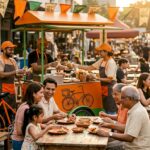
Street food is social dining by design: it creates spontaneous communal spaces where strangers gather, interact, and share far more than a meal. The sociological term for this is the “third place,” a concept developed by Ray Oldenburg in The Great Good Place), which identifies informal public spots as the neutral ground where community life actually happens. Singapore’s hawker centres, recognised by UNESCO as Intangible Cultural Heritage in 2020, are the world’s most studied proof of this principle. Robin Dunbar’s 2017 research confirms that eating together builds happiness, trust, and community bonds in ways that solitary or formal dining simply cannot replicate.
Why street food is social dining: the design behind the gathering
Street food venues are not accidentally social. They are structurally engineered to produce interaction. Open-air stalls, communal benches, and the absence of reservations all remove the barriers that make formal restaurants feel exclusive or transactional. When you sit down at a hawker centre in Singapore or a taco stand in Mexico City, you are placed into proximity with people you would never otherwise meet. That proximity, repeated over time, becomes community.
Ray Oldenburg’s third-place framework) argues that spaces between home and work are not luxuries but necessities for democratic, healthy societies. Street food venues fit this definition precisely. They are affordable, accessible, and voluntary. Nobody is required to be there, which means everyone who is there has chosen to be, and that shared choice creates an immediate, low-stakes social bond.
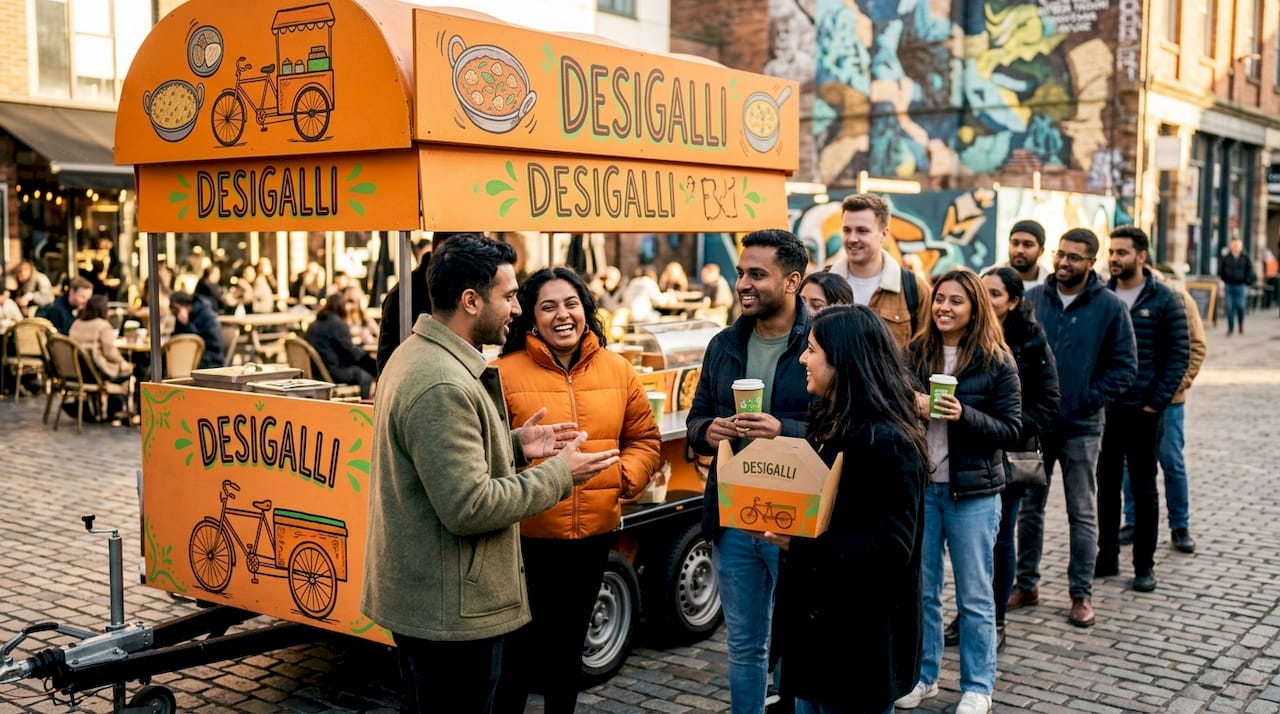
The physical design of these spaces reinforces the social dynamic. Communal tables mean you cannot avoid your neighbour. Queuing at a single counter means you share a moment of anticipation with strangers. The noise, the smells, and the visible theatre of cooking all give people something to comment on. These are not accidental features. They are the architecture of sociability.
Singapore’s hawker centres illustrate this at scale. Hundreds of stalls, thousands of diners, and yet the atmosphere is one of shared social infrastructure rather than anonymous consumption. The UNESCO recognition was not for the food alone. It was for the way these spaces hold communities together across ethnic, economic, and generational lines.
- Open seating removes social gatekeeping and invites strangers to share tables naturally.
- Visible food preparation gives diners a shared focal point and a reason to start conversations.
- Affordable pricing ensures the crowd is genuinely mixed, not filtered by income.
- No time limits allow meals to extend into conversation without commercial pressure.
Pro Tip: When visiting a street food market for the first time, sit at a communal table rather than finding a corner spot. The discomfort of proximity lasts about three minutes. The conversation that follows can last considerably longer.
How does eating street food together affect your wellbeing?
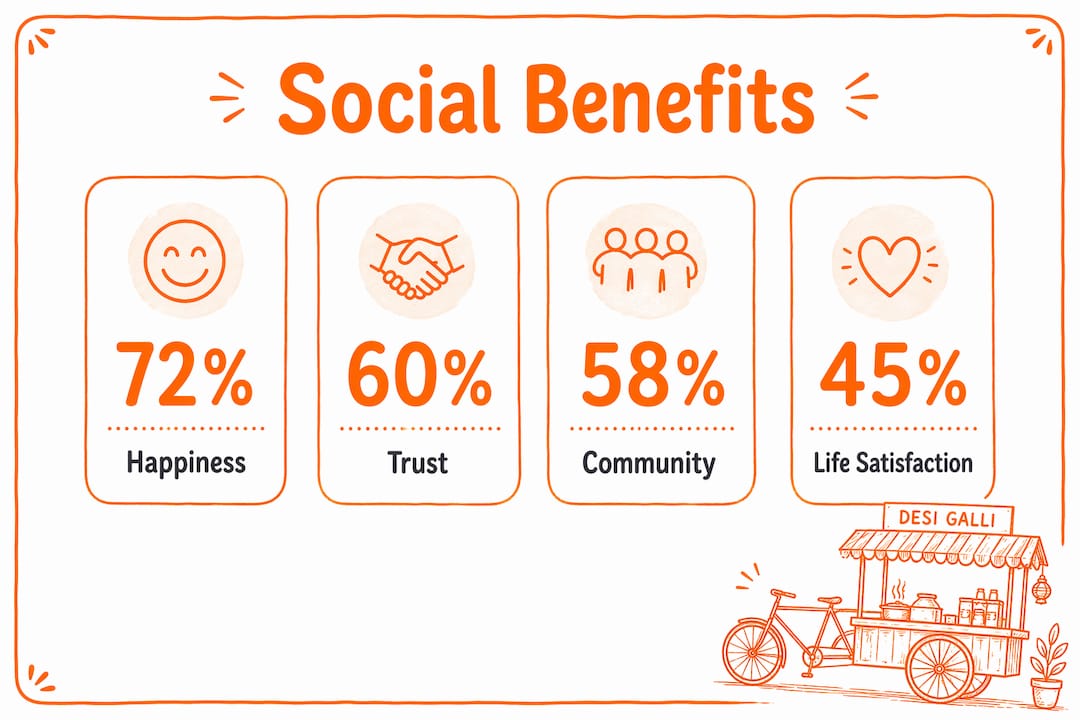
The social benefits of street food dining are not merely anecdotal. They are measurable, physiological, and consistent across cultures. Robin Dunbar’s 2017 “Breaking Bread” study found that social eating predicts happiness, life satisfaction, trust, and community engagement more reliably than almost any other social behaviour. Crucially, the direction of causality runs from eating together to bonding, not the other way around. You do not need to already be friends to benefit. The shared meal creates the friendship.
A 2026 study conducted in Singapore added a striking physiological dimension to this picture. Researchers found that eating with friends lowers postprandial blood glucose compared with eating alone, even when the food consumed is identical. This means that the social context of a meal changes how your body processes it. Street food gatherings are not just good for your mood. They are measurably good for your metabolic health.
The same Singapore study found that hawker centre meals account for 14% of all meals eaten by the study population. That is a significant share of daily nutrition being consumed in a communal, social setting. The implication is that street food culture is not a peripheral dining habit. It is a central pillar of how communities nourish themselves, both physically and socially.
“Eating together is one of the most powerful social acts humans perform. It signals trust, builds reciprocity, and creates the kind of repeated, low-stakes contact that turns strangers into neighbours.”
— Robin Dunbar, Oxford University
| Social benefit | What the research shows |
|---|---|
| Happiness and life satisfaction | Dunbar’s 2017 study links shared meals directly to higher reported wellbeing |
| Trust and community engagement | Regular communal eating correlates with stronger local social networks |
| Physiological health | Eating with friends reduces post-meal blood glucose response |
| Friendship formation | Shared dining creates bonds even between people who were previously strangers |
Contrast this with solitary dining, which research consistently associates with higher rates of loneliness, lower dietary quality, and reduced engagement with local community life. The street food stall, with its noise and its crowds and its lack of privacy, turns out to be one of the healthiest places you can eat.
Does affordability make street food more socially inclusive?
Accessibility is the mechanism that makes street food’s social role possible at scale. A 2026 study in Bandung, Indonesia, found that perceived accessibility was the sole statistically significant factor influencing whether people chose to purchase street food. The odds ratio was 4.6, meaning people with high perceived accessibility were 4.6 times more likely to eat street food than those who found it difficult to access. Price concerns and even hygiene perceptions were secondary. Convenience and cost were decisive.
This matters for the social dining argument because accessibility determines who shows up. When food is cheap and geographically close, the crowd that gathers is genuinely diverse. Office workers, students, retirees, tourists, and local families all converge at the same stalls. That diversity is not incidental. It is the raw material of social interaction. You cannot build community across class lines in a restaurant where the price of entry filters the clientele.
| Dining format | Accessibility | Social diversity | Spontaneity |
|---|---|---|---|
| Fine dining restaurant | Low (price, booking required) | Low | Very low |
| Casual café | Medium | Medium | Medium |
| Street food stall or market | High (price, no booking) | High | High |
The social benefits of street food are therefore inseparable from its economic model. The low price point is not just a commercial feature. It is a social policy. Street food markets in cities from Mumbai to Barcelona to Bangkok function as the dining rooms of the city, open to everyone, owned by no one, and shaped by the collective habits of their communities.
What social norms make street food dining work among strangers?
The most underappreciated aspect of street food culture is the invisible rulebook that governs it. Qualitative research into Singapore’s hawker centres reveals a self-organising social environment built on unspoken norms that allow thousands of strangers to share space with minimal friction. These norms are not posted on signs. They are transmitted through observation, imitation, and the gentle social pressure of a crowd that knows what it is doing.
The most famous of these is “chope-ing,” the practice of reserving a seat at a communal table by leaving a personal item, typically a packet of tissues, on the chair before going to order food. This single behaviour solves a coordination problem that would otherwise create constant conflict. It signals occupation without requiring verbal negotiation, and it is understood by every regular diner without ever being formally taught.
Here is how the broader system of social coordination operates in a well-functioning street food space:
- Queuing at stalls establishes turn-taking and signals patience as a shared value. Cutting the queue is a serious social offence, enforced by collective disapproval rather than rules.
- Chope-ing allows solo diners to secure a seat before ordering, reducing the anxiety of arriving alone and finding nowhere to sit.
- Tray return at centres with this system creates a collective responsibility for the shared space. Compliance is high because non-compliance is visible and socially costly.
- Sharing tables with strangers is the default, not the exception. The norm is to ask politely and sit down, not to wait for an empty table.
- Behavioural synchronisation occurs even without conversation. Diners mirror each other’s pace, noise level, and spatial awareness, creating a subconscious sense of shared experience.
Research into behavioural synchronisation in public dining shows that these non-verbal coordination mechanisms are a genuine form of social bonding. You do not need to speak to someone to feel connected to them. Sharing a physical rhythm, a space, and a purpose is sufficient.
Pro Tip: If you are new to a street food market, watch the regulars for five minutes before you order. The unspoken norms of queuing, seating, and table-sharing will become obvious, and following them will make you feel like a local within the hour.
The ritualistic aspects of Indian street food follow a similar logic. Sharing chaat from a single plate, passing around a cone of bhel puri, or gathering around a pani puri stall where the vendor serves each piece individually are all micro-rituals that create synchronised, shared experience. The food is the occasion. The social interaction is the point.
Key takeaways
Street food is social dining because its design, affordability, and unspoken norms actively produce community interaction, not merely accommodate it.
| Point | Details |
|---|---|
| Third-place design | Street food venues are structurally built to encourage voluntary, low-stakes social interaction. |
| Shared meals build bonds | Dunbar’s research shows communal eating creates happiness and trust, not just reflects it. |
| Accessibility drives diversity | Low price and geographic convenience attract mixed crowds, making social interaction more likely. |
| Unspoken norms reduce friction | Practices like chope-ing and queuing allow strangers to share space without conflict. |
| Physiological benefits | Eating with others measurably lowers post-meal blood glucose, per 2026 Singapore research. |
Street food is the antidote to modern social isolation
I have eaten street food on four continents, and the one constant is this: nobody eats alone for long. You arrive solo, you sit at a communal table, and within ten minutes you are discussing the best stall in the market with the person next to you. That does not happen in a restaurant. It does not happen at home. It happens at street food gatherings because the environment is designed, consciously or not, to make it happen.
What concerns me about the current moment is that cities are under pressure to “upgrade” their street food spaces into sanitised food halls with individual tables, reserved seating, and digital ordering. Every one of those changes removes a friction point that was actually doing social work. The queue was a conversation starter. The communal table was a forced introduction. The chaos of ordering at a counter was a shared experience. Remove those elements and you have a restaurant that happens to serve street food. The social dining experience is gone.
The UNESCO recognition of Singapore’s hawker centres was a rare moment of institutional acknowledgement that these spaces are cultural infrastructure, not just food venues. More cities need to make that argument for their own street food traditions before they are lost to redevelopment and gentrification. Barcelona’s food markets, Mumbai’s chaat stalls, Bangkok’s night markets: these are not tourist attractions. They are the social fabric of their cities, and they deserve protection as such.
My honest recommendation: eat street food with intention. Go with someone you want to know better. Sit at the communal table. Order something you have never tried. The food will be good. The conversation will be better.
— YellowRock
Experience authentic Indian street food in Barcelona
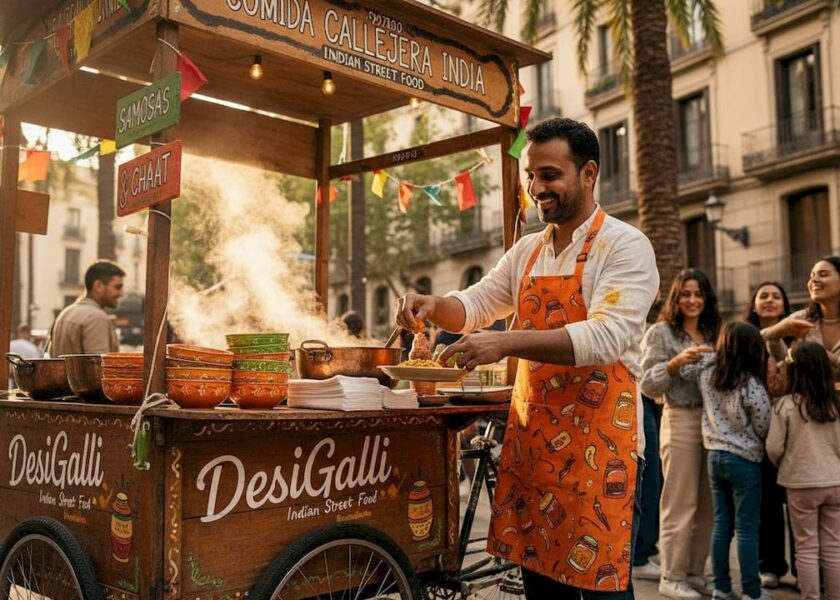
Desigallibcn brings the communal energy of Indian street markets to the heart of Barcelona. The restaurant’s casual, open atmosphere mirrors the social dining principles explored in this article: shared tables, bold flavours served without ceremony, and a menu built around the kind of food that people gather around. Dishes like chaat, samosas, and pani puri are inherently social foods, designed to be shared, passed around, and eaten in company. If you want to understand why street food and community are inseparable, the best way is to experience it directly. Explore the Indian street food menu at Desigallibcn and book a table for your next social dining occasion.
FAQ
Why is street food considered social dining?
Street food is social dining because its open settings, communal tables, and affordable pricing bring together diverse groups of people in shared public spaces. Ray Oldenburg’s third-place theory identifies these venues as the neutral ground where voluntary community interaction naturally occurs.
What does research say about the benefits of eating together?
Robin Dunbar’s 2017 “Breaking Bread” study found that social eating directly increases happiness, trust, and community engagement. A 2026 Singapore study added that eating with friends also lowers post-meal blood glucose compared with eating alone.
How does affordability affect street food’s social role?
A 2026 study in Bandung, Indonesia, found that perceived accessibility was 4.6 times more influential than other factors in driving street food purchases. Low cost and convenient location attract genuinely mixed crowds, which is the foundation of street food’s social diversity.
What are the unspoken rules of street food dining?
Practices like queuing, chope-ing (reserving seats with a personal item), and tray return create a self-organising social system. Research into Singapore’s hawker centres shows these norms allow thousands of strangers to share space with minimal conflict and no formal enforcement.
Is Indian street food a social dining experience?
Indian street food is built around shared, communal eating rituals. Dishes like chaat and pani puri are served and consumed in groups, with vendors often serving each piece individually to create a shared rhythm. This makes Indian street food culture one of the richest examples of social dining in the world.
Recommended
- Advantages of street food experience: a global guide – Desi Galli
- What is Mumbai street food: a cultural guide – Desi Galli
- Indian street food: Flavours, rituals and where to try in Barcelona – Desi Galli
- Why Indian street food is popular in Barcelona – Desi Galli