
Indian cuisine is defined as a mosaic of regional traditions and cultural meanings, shaped by climate, agriculture, religion, and centuries of global trade. No single dish or spice represents it fully. The cultural facts about Indian cuisine reveal a living system where food carries spiritual weight, social identity, and nutritional philosophy all at once. From the wheat flatbreads of Punjab to the rice-based curries of Kerala, every plate tells a story that goes far beyond flavour. This guide unpacks the most revealing layers of that story for food enthusiasts and cultural explorers.
1. What are the key cultural facts about Indian cuisine’s regional diversity?
Indian cuisine is a mosaic of distinct regional styles, not a single unified cooking tradition. Geography and agriculture drive those differences more than any other factor.
- North India relies on wheat as its staple crop. Breads like roti, naan, and paratha dominate the table. Dairy products such as paneer and ghee appear in almost every dish.
- South India is built around rice. Dishes like dosa, idli, and sambar reflect a wet climate suited to paddy farming. Coconut and tamarind replace the cream-based sauces of the North.
- East India, particularly Bengal and Odisha, combines rice with mustard oil and freshwater fish. The flavour profile is lighter and more pungent than either North or South.
- West India splits dramatically. Rajasthan produces dry, spice-heavy dishes suited to desert conditions. Goa, shaped by Portuguese contact, uses vinegar and chilli in ways unique to the subcontinent.
Regional Indian dishes are not isolated inventions. Ingredients and techniques moved across trade networks and empires for centuries, meaning every regional style carries traces of outside influence. That movement is what makes the food culture of India so layered.
Pro Tip: When exploring Indian food for the first time, try dishes from two contrasting regions side by side. A North Indian dal makhani next to a South Indian rasam reveals more about Indian cooking customs than any single dish can.
2. How does religion shape Indian food traditions?
The diversity of Indian cuisine is as much about community identity and religious rules as it is about culinary technique. Dietary restrictions are not obstacles to creativity. They are the engine of it.
- Jain vegetarianism prohibits root vegetables such as onions, garlic, and potatoes because harvesting them kills the whole plant. Jain cooks developed an entire cuisine of remarkable complexity without these staples.
- Hindu food customs vary by caste, region, and deity. Many upper-caste Hindu households avoid beef entirely. Others observe fasting days that exclude grains, shifting the diet to fruit, dairy, and specific flours.
- Islamic dietary law prohibits pork and requires halal slaughter. Mughal court cuisine, which shaped North Indian cooking profoundly, developed within these constraints and produced dishes like biryani and korma.
- Buddhist influence in parts of Northeast India and among certain communities promotes non-violence toward all living beings, reinforcing vegetarian cooking customs in India.
“Indian food traditions emphasise offering, nourishing, including, and healing rather than a single authenticity standard.” — Time
The vegetarian traditions of India are not a modern trend. They are ancient systems refined over thousands of years by communities whose identity was inseparable from what they ate and how they prepared it.
3. What is Ayurveda’s role in Indian meal design?
Ayurvedic food philosophy recognises six tastes that every balanced meal should include: sweet, sour, salty, bitter, pungent, and astringent. This is not a modern wellness concept. It is a framework that has shaped Indian cooking customs for over two thousand years.
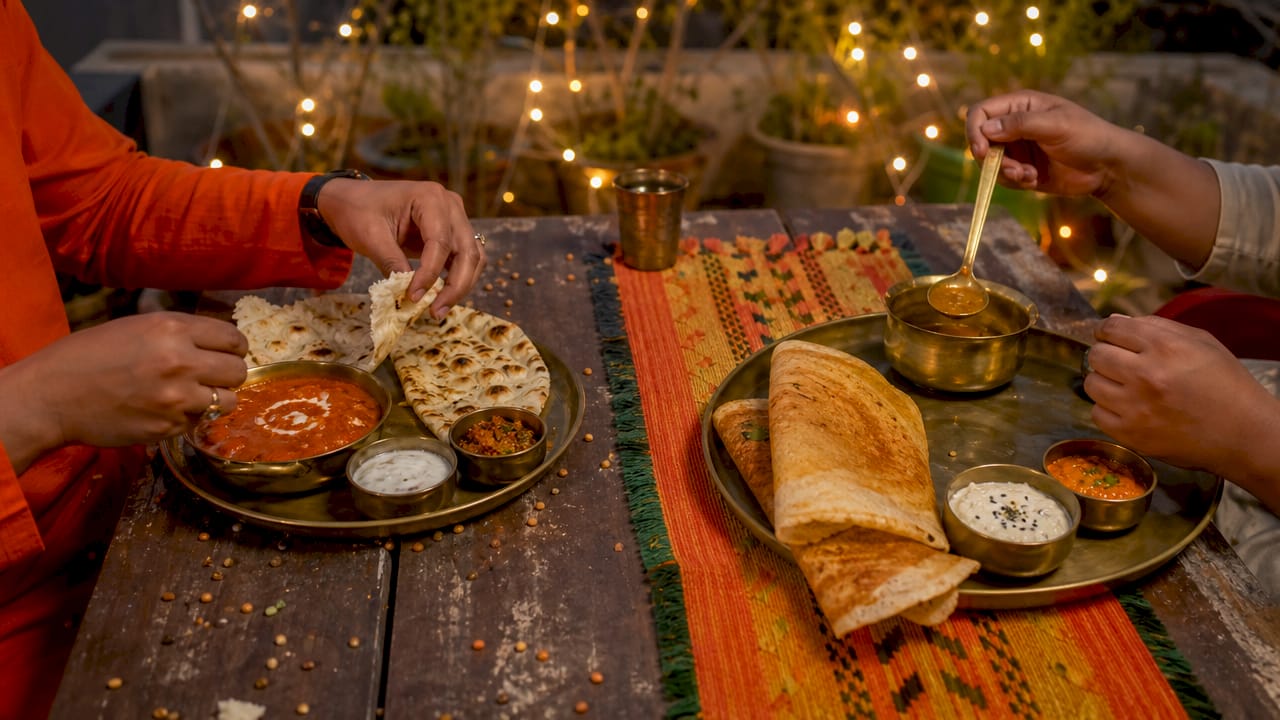
The Indian thali is the most visible expression of this philosophy. A standard thali places multiple small dishes on a single platter, each contributing a different taste. Dal provides protein and earthiness. A sweet chutney balances the pungency of pickles. A bitter vegetable dish like karela offsets the richness of ghee. The thali meal format reflects a sophisticated understanding of nutrition and satisfaction that predates modern diet science.
| Ayurvedic taste | Common source in a thali | Effect on digestion |
|---|---|---|
| Sweet | Rice, dal, kheer | Builds tissue, calms the body |
| Sour | Tamarind chutney, yoghurt | Stimulates appetite and digestion |
| Salty | Pickles, papad | Enhances flavour, aids absorption |
| Bitter | Karela, methi | Detoxifies, reduces heaviness |
| Pungent | Chilli, ginger, pepper | Stimulates metabolism |
| Astringent | Lentils, pomegranate | Firms tissue, reduces excess moisture |
Presentation carries cultural meaning too. Serving on a banana leaf is not merely decorative. The leaf is considered pure, biodegradable, and believed to add subtle flavour. Metal thali platters signal a more formal or festive occasion. Eating sequence also matters. Sweet dishes often come first in South Indian tradition to prime digestion, while North Indian custom typically ends with something sweet.
Pro Tip: When sampling a thali, resist eating everything at once. Move through the dishes in the order they are served. The sequence is deliberate and affects how each flavour lands.
4. How did trade and colonialism change spices in Indian cuisine?
The Portuguese introduced chilli peppers and New World vegetables including tomatoes and potatoes to India in the 16th century. This single contact reshaped Indian flavour profiles across every region. It is difficult to imagine a vindaloo, a butter chicken, or a potato-stuffed samosa without these introductions, yet none of them existed before 1500.
- Mughal and Central Asian influence brought techniques such as slow-cooking in sealed pots (dum cooking), the use of dried fruits and nuts in savoury dishes, and the layered rice dish that became biryani.
- Portuguese contact introduced not only chilli but also vinegar-based preservation, which became central to Goan cuisine. The word “vindaloo” derives from the Portuguese “vinha d’alhos,” meaning wine and garlic.
- British colonial influence introduced baking as a widespread technique and brought vegetables like cauliflower, which now appears in dishes like aloo gobi across North India.
- Ancient trade routes connecting India to Persia, Arabia, and Southeast Asia had already seeded the subcontinent with black pepper, cardamom, and cinnamon long before European contact.
| Influence | Period | Key contribution |
|---|---|---|
| Ancient trade routes | Pre-1000 CE | Black pepper, cardamom, cinnamon |
| Mughal and Central Asian | 1526 onwards | Dum cooking, biryani, dried fruit in savoury dishes |
| Portuguese | 16th century | Chilli, tomato, potato, vinegar |
| British colonial | 18th–20th century | Baking techniques, cauliflower |
Historical Indian recipes show that Indian cuisine was never static. Each wave of contact added ingredients and methods that cooks absorbed and made entirely their own. The result is a food culture that is simultaneously ancient and constantly evolving.
5. What are the cultural rules behind Indian dining etiquette?
Indian dining etiquette is governed by principles that go deeper than table manners. Ancient texts prescribe food purity rules that treat who touched the food and how it was handled as equally important as the food itself. Visitors to Indian homes often encounter these customs without realising their origin.
- Eating with the right hand is standard across most of India. The left hand is considered impure for food contact. This rule applies whether eating rice, bread, or street food.
- Washing hands before and after eating is not optional etiquette. It is a ritual act rooted in concepts of purity that predate modern hygiene science.
- Not wasting food carries moral weight. Leaving a plate entirely full is considered disrespectful to the cook and to the act of nourishment itself.
- Serving others before yourself is a mark of respect, particularly toward elders. Hosts in many Indian households will insist on filling your plate repeatedly as a sign of hospitality.
- Flavour contrasts are deliberate. A meal will typically include something cooling like raita alongside something fiery. This is not accidental. Eating etiquette incorporates purity and sensory logic where contrasting flavours stimulate and then soothe digestion in sequence.
Communal eating reinforces social bonds in Indian culture. Sharing food from a common pot or eating together at a wedding feast signals trust and belonging. The cultural meaning behind food presentation is inseparable from the social act of eating together.
Key takeaways
Indian cuisine is best understood as a system of regional, spiritual, and historical layers, where every ingredient, meal format, and dining custom carries meaning beyond taste.
| Point | Details |
|---|---|
| Regional diversity is foundational | Wheat dominates the North; rice defines the South and East, shaping entirely different dish traditions. |
| Religion drives dietary innovation | Jain, Hindu, Islamic, and Buddhist food rules have produced distinct and complex cooking traditions across India. |
| Ayurveda informs meal structure | The six-taste thali format reflects nutritional philosophy that predates modern diet science. |
| Trade reshaped Indian flavours | Portuguese, Mughal, and British contact introduced chilli, dum cooking, and baking, permanently changing Indian cuisine. |
| Etiquette carries ritual meaning | Rules around hand use, food purity, and serving order connect to ancient texts, not just social convention. |
Why I think most people miss the real depth of Indian food
Most food writing about India focuses on famous dishes: butter chicken, biryani, samosas. Those dishes are genuinely excellent. But they represent a tiny fraction of what Indian food culture actually contains.
The most revealing thing I have found when studying Indian cuisine is how much of it lives in everyday kitchens and rituals rather than in restaurant menus. A grandmother in Tamil Nadu adjusting the sourness of her rasam based on who is unwell that day is practising Ayurvedic medicine. A Jain cook in Gujarat producing a dish of extraordinary complexity without onion or garlic is demonstrating centuries of constraint-driven creativity. Neither of these moments appears on a typical menu.
The cultural context behind food choices matters enormously. When you understand that a thali is not just a convenient way to serve many dishes but a deliberate application of taste-balancing philosophy, the meal changes. You stop eating it as a collection of sides and start reading it as a culinary experience with internal logic.
My recommendation for any cultural explorer is to resist the urge to rank Indian dishes or find a single “authentic” version. Authenticity in Indian food is plural. It belongs to communities, not critics. The most honest way to engage with it is to ask where a dish comes from, who makes it, and what rules shaped it. Those questions will take you somewhere far more interesting than any restaurant guide.
— YellowRock
Indian street food culture, brought to Barcelona by Desigallibcn
Desigallibcn brings the energy of Indian street markets to the heart of Barcelona, where the cultural facts about Indian cuisine come alive on the plate. The menu draws on the regional diversity and bold spice traditions explored above, from crispy samosas to chaat loaded with contrasting flavours.
Whether you want to experience the street food rituals of India or try signature Indian street desserts that carry centuries of tradition in every bite, Desigallibcn is the place to start. The restaurant also offers a strong selection of vegetarian and vegan dishes that reflect the deep plant-based traditions of Indian cooking. Book a table and taste the culture directly.
FAQ
What makes Indian cuisine so regionally diverse?
Indian cuisine varies by region because climate, agriculture, and local culture each determine which ingredients are available and how they are used. Wheat dominates the North while rice defines the South and East.
Why is vegetarianism so prominent in Indian food traditions?
Religious communities including Jains, many Hindus, and Buddhists have practised vegetarianism for thousands of years. These traditions produced complex, flavour-rich cooking systems that require no meat to achieve depth.
What is the significance of the Indian thali?
The thali reflects Ayurvedic taste-balancing philosophy, incorporating all six recognised tastes in a single meal. The sequence of eating and the presentation on banana leaf or metal platter both carry cultural meaning.
How did chilli become central to Indian cooking?
The Portuguese introduced chilli peppers to India in the 16th century. Before that introduction, Indian cooks used black pepper and long pepper for heat. Chilli was absorbed so thoroughly that it now feels inseparable from Indian cuisine.
What should I know about Indian dining etiquette before visiting?
Eating with the right hand, washing hands before and after meals, and not wasting food are the three most universal customs. These rules connect to ancient purity principles rather than modern social convention.
Recommended
- Why embrace indian street flavours: a cultural guide – Desi Galli
- Defining authentic Indian restaurants: the real guide – Desi Galli
- Indian flavours: Authentic tastes and culinary secrets – Desi Galli
- What is indian comfort food? a cultural guide – Desi Galli