

Indian chutney is a flavour-packed condiment central to Indian cooking, existing in two primary forms: fresh herb-based preparations consumed within 24 hours, and cooked preserves stabilised by sugar and acidity for a longer shelf life. The word “chutney” derives from the Hindi chatni, meaning to lick or taste, which tells you everything about its purpose. Far from a simple dipping sauce, chutney is a structural element of Indian cuisine, balancing heat, sweetness, sourness, and salt in a single spoonful. Whether you are new to Indian cooking or deepening your repertoire, understanding chutney unlocks the logic behind why Indian food tastes so complete.
What is Indian chutney and how does it differ from other condiments?
Indian chutney is defined by its deliberate flavour contrast. Western condiments like ketchup or mustard typically deliver one dominant note. Chutney delivers several simultaneously. A single green coriander chutney can be sharp, herbal, spicy, and faintly sweet all at once. That complexity is the point.
Chutney varieties across India reflect regional identity rather than a single national recipe. Coconut chutney is the default accompaniment in Tamil Nadu and Kerala. Kasundi, a pungent mustard chutney, belongs to Bengal. Walnut chutneys appear in Kashmiri cooking. Garlic chutneys are a Rajasthani staple. Each variety carries a region’s culinary memory and shows what ingredients were historically available.

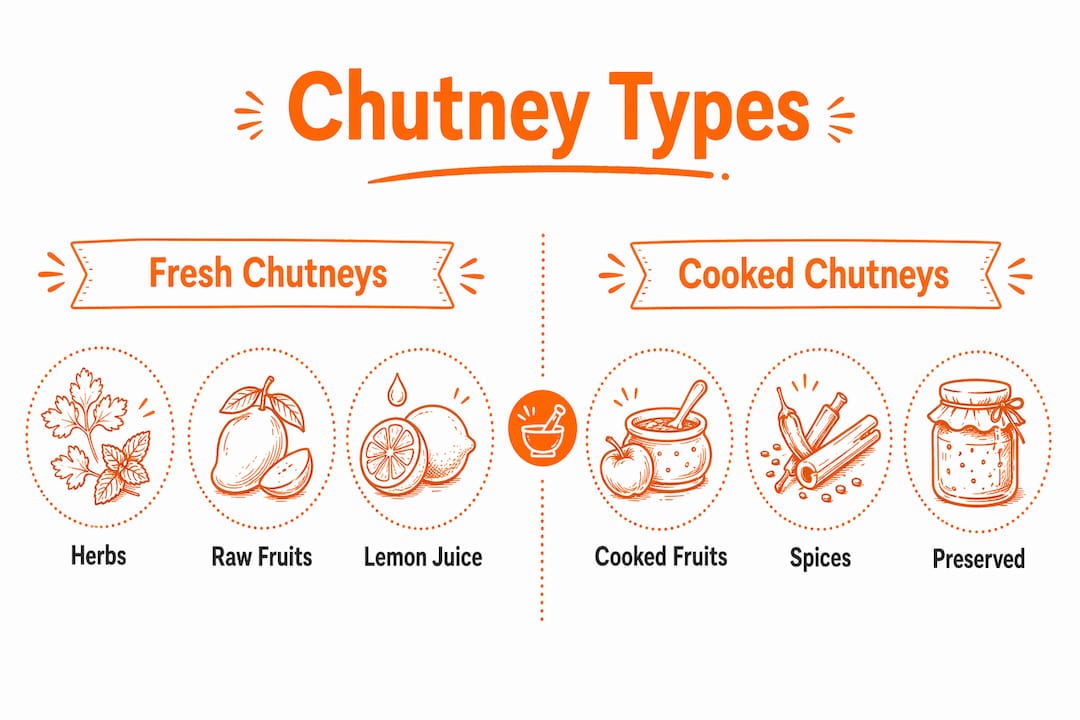
The two broad categories are fresh chutneys and cooked chutneys. Fresh chutneys use raw herbs, fruits, or vegetables blended with acid and spice. Cooked chutneys use heat, sugar, and vinegar to create shelf-stable preserves closer to jam in texture. Both serve the same fundamental purpose: to add a contrasting flavour layer to the main dish.
What are the main types of Indian chutney?
The range of Indian chutneys is wider than most home cooks realise. Here are the most common varieties you will encounter:
- Green coriander chutney (hari chutney): Fresh coriander, green chillies, garlic, lemon juice, and salt blended into a bright, sharp paste. The most universal chutney in Indian street food.
- Mint chutney (pudina chutney): Similar base to hari chutney but with mint as the dominant herb. Cooler and slightly sweeter in character.
- Tamarind chutney (imli chutney): A cooked chutney made from tamarind pulp, jaggery, and spices. Dark, sticky, and sweet-sour. Standard in chaat dishes.
- Coconut chutney: Ground fresh coconut with green chillies, ginger, and a tempering of mustard seeds and curry leaves. Served with dosas and idlis across South India.
- Tomato chutney: Cooked down with onions, chillies, and spices. Ranges from tangy to deeply smoky depending on the region.
- Garlic chutney (lehsun chutney): Dry or wet, made with raw or roasted garlic, dried red chillies, and coconut or peanuts. Intense and fiery.
The table below shows how fresh and cooked chutneys differ in practical terms:
| Feature | Fresh chutneys | Cooked chutneys |
|---|---|---|
| Key ingredients | Herbs, raw fruits, lemon juice | Fruits, sugar, vinegar, spices |
| Shelf life | Up to 24 hours | Weeks to months |
| Texture | Smooth or coarsely ground | Thick, jammy, or syrupy |
| Flavour profile | Bright, sharp, herbaceous | Deep, sweet, sour, complex |
| Common examples | Coriander, mint, coconut | Tamarind, mango, tomato |
What ingredients make up an authentic Indian chutney?
Authentic chutneys follow a four-part structure: a base, an acid, a sweetener, and a heat source. Every element has a specific job.
The base provides body and the dominant flavour. Fresh herbs like coriander and mint, fruits like raw mango or tamarind, and grated coconut are the most common bases. The acid sharpens the chutney and cuts through richness. Tamarind is the most traditional acid, but lemon juice and vinegar both appear depending on the region and recipe. The sweetener rounds off sharp edges. Jaggery, an unrefined cane sugar with a slight molasses note, is preferred over refined sugar in traditional recipes because it adds depth rather than plain sweetness.
The heat source is non-negotiable. Green chillies go into fresh chutneys. Dried red chillies, often toasted, go into cooked and dry chutneys. The heat level is adjusted by removing seeds or using milder varieties. Beyond these four pillars, spices like cumin, mustard seeds, and asafoetida add aromatic complexity. A tempering of mustard seeds and curry leaves fried briefly in oil is poured over coconut chutney to finish it. That technique, called tadka or tarka, transforms a simple paste into something layered and fragrant.
Pro Tip: If your fresh chutney tastes flat, the problem is almost always insufficient acid. Add lemon juice a teaspoon at a time and taste after each addition. The brightness you are looking for comes from acid, not from adding more herbs.
Why are chutneys so important in Indian food?
Chutneys make up at least 20% of a traditional thali, the classic Indian platter meal. That proportion is not decorative. It reflects how central chutneys are to the meal’s overall balance. Indian culinary philosophy recognises six fundamental tastes: sweet, sour, salty, pungent, bitter, and astringent. A well-composed thali addresses all six, and chutneys carry several of those notes simultaneously.
The role of chutneys in Indian food extends beyond flavour. Acidity in chutneys stimulates digestion and cleanses the palate, particularly when eaten alongside oily or fried dishes. This is why a sharp green chutney always accompanies samosas and pakoras. The acid cuts through the fat, preventing the heavy, cloying feeling that fried food can produce. Chutney is doing functional work, not just adding flavour.
In Indian street food, the importance of chutneys becomes even clearer. Mumbai’s Vada Pav uses a trio of chutneys: dry garlic chutney pressed into the bread, green chutney for freshness, and tamarind chutney for sweetness. Remove any one of them and the dish collapses into something flat and one-dimensional. The chutneys are not optional extras. They are structural.
Celebrity chef Sanjeev Kapoor describes chutneys as quiet voices of Indian cuisine that carry memory and identity, transforming a dish’s tone and emotion. That framing captures something real. A home cook’s coriander chutney, made to a grandmother’s proportions, tastes different from any commercial version. The improvisation and personal touch in traditional home chutneys is precisely what commercial products cannot replicate.
“Chutneys are the quiet voices of Indian cuisine. They carry memory and identity, transforming the tone and emotion of a dish.” — Sanjeev Kapoor
You can see the role of chutneys in Indian cuisine most clearly when you look at how they pair with Indian dishes across different meal formats. A biryani served with a cooling raita and a sharp onion chutney is a complete experience. The same biryani served alone is just rice and meat.
How can home cooks make and use Indian chutneys?
Making chutney at home is one of the most accessible entry points into Indian cooking. Fresh chutneys require no cooking and come together in under ten minutes. Cooked chutneys take longer but reward patience with depth and complexity.
For fresh chutneys, the method matters as much as the ingredients. Grinding with a stone mortar and pestle, known as a sil-batta in Hindi, preserves texture and flavour better than a mechanical blender. Stone grinding maintains the cellular structure of herbs and spices, releasing oils more gradually and producing a coarser, more flavourful result. A blender is faster and perfectly acceptable for everyday use, but the texture will be smoother and slightly less complex.
Storage is straightforward once you understand the two categories. Fresh chutneys should be refrigerated immediately and consumed within 24 hours. Adding a thin layer of oil on top before refrigerating slows oxidation and keeps green chutneys from browning. Cooked chutneys can be stored in sterilised jars for several weeks. Tamarind chutney keeps particularly well and actually improves after a few days as the flavours deepen.
Here are the most useful pairings to start with:
- Green coriander chutney: Samosas, pakoras, dosas, sandwiches, grilled meats
- Tamarind chutney: Chaat dishes, papdi, bhel puri, dahi puri
- Coconut chutney: Idli, dosa, uttapam, medu vada
- Mint chutney: Kebabs, seekh kebab, tikka, wraps
- Tomato chutney: Rice dishes, lentil dishes, grilled vegetables
Traditional chutney recipes often use kitchen leftovers: coriander stalks, vegetable peels, and overripe fruit. This reflects cultural resourcefulness rather than carelessness. Coriander stalks, for instance, carry more flavour than the leaves. Using them produces a more intense chutney, not a lesser one.
Pro Tip: Freeze fresh green chutney in an ice cube tray. Each cube gives you a single serving portion, ready to defrost in minutes. This preserves the bright colour and flavour far better than refrigerating a large batch.
For home cooks exploring Indian street food pairings, starting with a green coriander chutney and a tamarind chutney covers the majority of classic combinations. Those two chutneys together represent the fresh-and-sharp versus sweet-and-sour contrast that defines Indian street food flavour.
Key takeaways
Indian chutney is a structural condiment, not a garnish. Its role in balancing flavour, aiding digestion, and defining regional identity makes it one of the most important elements in Indian cooking.
| Point | Details |
|---|---|
| Two core categories | Fresh herb chutneys last 24 hours; cooked preserves last weeks to months. |
| Four-part flavour structure | Every authentic chutney has a base, an acid, a sweetener, and a heat source. |
| Functional role in meals | Chutneys balance all six tastes in Indian cuisine and stimulate digestion alongside oily food. |
| Regional identity | Coconut chutney, kasundi, walnut chutney, and garlic chutney each belong to a specific Indian region. |
| Home cooking tip | Stone grinding preserves texture; freeze fresh chutney in ice cube trays for convenient portions. |
Chutney as cultural memory: a personal reflection
Most food writing treats chutney as a supporting character. I think that framing misses the point entirely. In my experience, chutney is often the most revealing thing on the plate. It tells you where the cook is from, what season it is, and how much care went into the meal.
The improvisation involved in traditional chutney-making is something commercial products will never capture. A home cook adjusts by instinct, adding more tamarind because the mangoes are sweeter this week, or swapping dried chillies for fresh ones because that is what is in the kitchen. That responsiveness to ingredients and context is what makes home chutney taste alive in a way that a jarred product simply does not.
What I find genuinely interesting is how chutney functions as a culinary experience marker. When you taste a chutney made by someone who grew up eating it, you are tasting accumulated knowledge. The proportions are not written down anywhere. They exist in muscle memory and sensory judgement built over years. That is not mysticism. It is craft.
My honest recommendation for any home cook: resist the urge to follow a chutney recipe rigidly. Use it as a starting point. Taste constantly. Adjust the acid, the heat, and the sweetness until the chutney makes you want to lick the spoon. That instinct is exactly what the word chatni was always pointing at.
— YellowRock
Taste authentic Indian chutney at Desigallibcn in Barcelona

Desigallibcn brings the real flavours of Indian street food to the heart of Barcelona. Every dish on the menu is built around the same principles described in this article: bold spice, deliberate flavour contrast, and chutneys that do genuine culinary work rather than sitting decoratively on the side. Samosas arrive with green coriander chutney and tamarind chutney. Chaat dishes are layered with the sweet-sour-sharp combinations that define the genre. If you want to understand what Indian chutney actually tastes like in context, the best way is to experience it alongside the Indian street food classics it was designed to accompany. Visit Desigallibcn to explore the full menu and book your table.
FAQ
What is Indian chutney made from?
Indian chutney is made from a base ingredient such as fresh herbs, fruit, or coconut, combined with an acid like tamarind or lemon juice, a sweetener such as jaggery, and a heat source such as green or red chillies.
How long does fresh Indian chutney last?
Fresh herb-based chutneys should be consumed within 24 hours and stored in the refrigerator. Cooked chutneys preserved with sugar and vinegar can last several weeks when stored in sterilised jars.
What is the difference between green chutney and tamarind chutney?
Green chutney is a fresh preparation made with coriander or mint, delivering a sharp and herbaceous flavour. Tamarind chutney is a cooked preserve with a deep sweet-sour profile, made from tamarind pulp and jaggery.
Why is chutney served with Indian street food?
Chutneys cut through the oiliness of fried snacks like samosas and pakoras, preventing palate fatigue and adding contrasting flavour. In dishes like Vada Pav, multiple chutneys create a multi-layered flavour experience that defines the dish.
Can I make Indian chutney without a blender?
A stone mortar and pestle produces superior results to a blender for most fresh chutneys, preserving texture and releasing flavour oils more gradually. A blender works well for everyday use and produces a smoother, slightly less complex result.
Recommended
- El Chutney en la Gastronomía India: Sabor y Equilibrio – Desi Galli
- Essential Indian food tips for beginners: master authentic flavours – Desi Galli
- How to pair indian dishes: a home cook’s guide – Desi Galli
- Indian spices list 2026: a home cook’s guide – Desi Galli