A street food hosting workflow is the structured process event planners use to organise, manage, and execute street food events from first permit application through to final load-out. Without a defined workflow, even well-funded events collapse under permit delays, vendor confusion, and guest bottlenecks. The industry term for this process is event operations management, though “street food hosting workflow” captures the specific, vendor-centred nature of the work. Get it right and you create an experience guests remember. Get it wrong and you spend the day firefighting. This guide covers every stage, from legal groundwork to on-site coordination, with concrete examples drawn from real operational practice.
What does a street food hosting workflow actually involve?
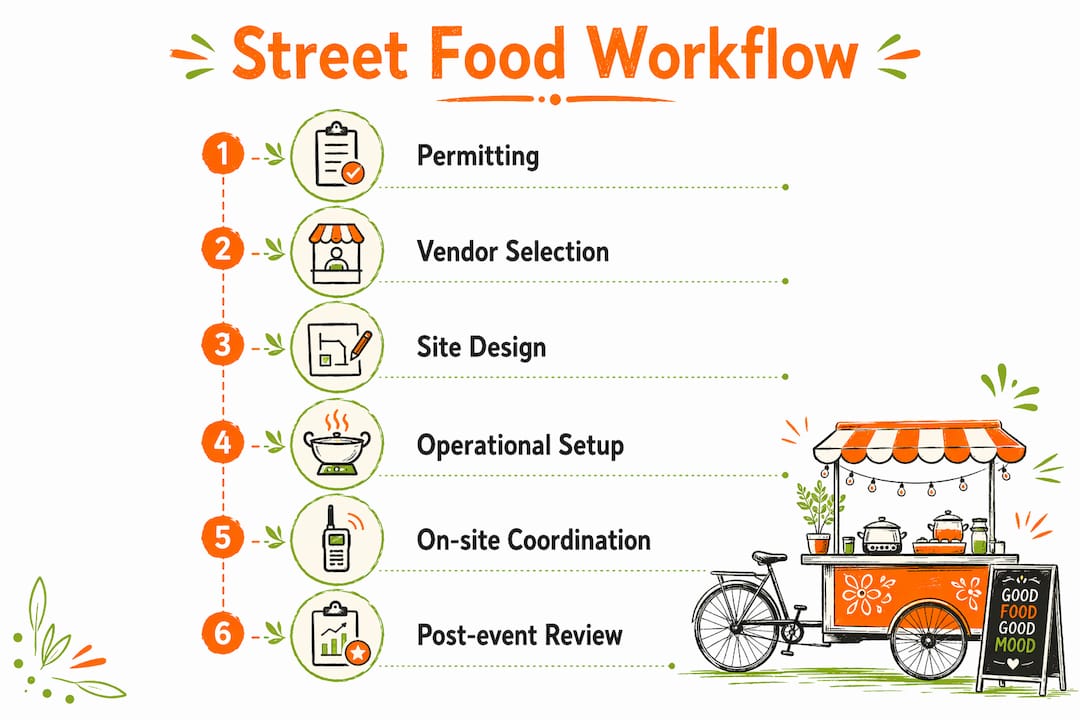
A street food hosting workflow covers six core stages: permitting, vendor selection, site design, operational setup, on-site coordination, and post-event review. Each stage depends on the one before it. Miss a step and the knock-on effect compounds quickly. The workflow is not a checklist you complete once. It is a living document you refine with every event you run.
Street food event management differs from standard catering in one critical way. You are coordinating multiple independent businesses, each with their own equipment, staff, and service pace. That complexity demands a workflow built around communication, not assumption.
What permits and prerequisites are essential before hosting street food?
Permits are the single biggest cause of last-minute event failures. Temporary food permit applications must be submitted 2–4 weeks before an event, with large festivals requiring a minimum of 30 days’ notice. Missing that window does not mean a delay. It means exclusion.
The permits you typically need fall into four categories:
- Food handling licences for each individual vendor operating on site
- Alcohol licences if any stall serves beer, wine, or spirits
- Sound permits for live music, PA systems, or amplified entertainment
- Site access and temporary structure permits for marquees, generators, and power rigs
Permit application deadlines are non-negotiable. Local authorities do not grant extensions for organisers who apply late. Build your permit timeline backwards from your event date and add a buffer of at least five working days for each application.
Insurance is equally non-negotiable. Public liability cover protects you if a guest is injured. Product liability cover protects you if a vendor’s food causes illness. Both are standard requirements for any licensed venue or council-owned space.
Pro Tip: Create a shared permit tracker in Google Sheets or Notion, with each vendor’s licence status, expiry date, and document upload link visible to your whole team. Chase outstanding documents weekly, not the week before the event.
Year-one permit and licensing costs for small mobile vendors typically range from $400 to $1,500 depending on city regulations. That figure matters when you are negotiating vendor fees. Vendors carrying that cost need stall fees that reflect their overhead, not just your footfall projections.
How to design an effective vendor setup for street food stalls
Vendor layout is where most event planners underinvest. A poorly designed site creates queues that block other stalls, slows service, and frustrates guests within the first hour.
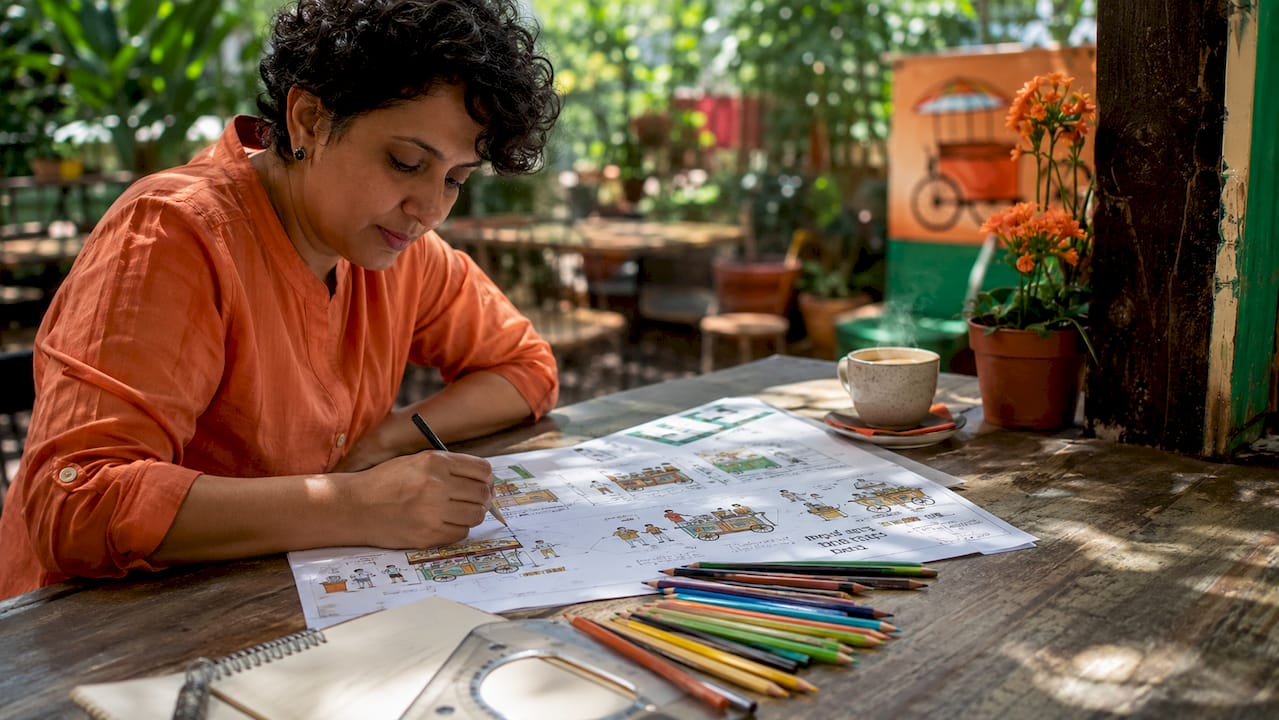
The most effective layout follows a loop workflow. Designing a loop layout means each vendor moves through a fixed sequence: order, cook, plate, garnish, serve, collect payment. Every tool and ingredient sits within reach, enabling one-handed workflows that maximise speed. Vendors who deviate from this sequence during a rush create bottlenecks that back up the entire queue.
Balancing your vendor roster
A curated vendor roster built around signature mains, dessert stalls, and beverage partners creates a better visitor experience and improves long-term market viability. The goal is not variety for its own sake. It is deliberate balance.
A strong roster for a 500-person event typically looks like this:
- Two or three main dish vendors covering different cuisine styles or dietary needs
- One dedicated dessert stall to extend dwell time after the main meal
- One or two beverage partners including non-alcoholic options
- One wildcard vendor offering something unexpected, such as a chaat counter or a live-fire grill
Successful street food events are curated experiences, not open bazaars. Limiting your vendor count and selecting thoughtfully produces better results than filling every available pitch.
| Vendor type | Recommended ratio | Purpose |
|---|---|---|
| Main dish stalls | 40–50% of roster | Core food offering and footfall driver |
| Dessert and snack stalls | 20–25% of roster | Dwell time and secondary spend |
| Beverage stalls | 20–25% of roster | Guest comfort and margin contribution |
| Specialist or wildcard | 10–15% of roster | Differentiation and social media appeal |
Pro Tip: Ask each vendor to submit a technical requirements sheet covering power draw in watts, water needs, and gas cylinder storage before you finalise the site plan. Surprises on event day cost time and money.
Contracts for custom food unit builds should detail technical and compliance requirements, tying final payment to inspection readiness. That clause protects you from vendors who arrive with equipment that fails a safety check on the morning of the event.
What operational workflows ensure smooth on-site coordination?
On-site coordination is where a well-planned event either holds together or falls apart. The difference is almost always communication infrastructure, not staffing numbers.
Point-of-sale (POS) systems and kitchen display systems (KDS) are the backbone of multi-vendor order management. A POS routes orders to the correct vendor in real time. A KDS displays those orders at the prep station without paper tickets. Together, they reduce errors and allow you to monitor service pace across the whole site from a single dashboard.
Clear communication tools such as SMS alerts and standardised labelling reduce chaos and improve guest flow at multi-vendor events. That is not a minor operational detail. At a 400-person event, a single mislabelled order can trigger a cascade of complaints that ties up your team for twenty minutes.
Bagging, labelling, and delivery protocols
Multi-vendor events benefit from vendors owning their own bagging and labelling, while drivers or runners act as assemblers. Each vendor bags their item, labels it with the order number and any allergen flags, and places it in a designated collection zone. The runner assembles the full order from that zone. This separation prevents cross-contamination and eliminates the most common source of order confusion.
The load-in and load-out schedule deserves as much attention as the event programme itself. Assign each vendor a specific arrival window, pitch number, and departure slot. Stagger arrivals by 20 minutes to prevent vehicle congestion. Confirm the schedule by SMS or WhatsApp the evening before the event.
| Coordination task | Tool or method | Timing |
|---|---|---|
| Vendor arrival scheduling | Staggered 20-minute slots | 48 hours before event |
| Order routing | POS and KDS system | Live on event day |
| Allergen and order labelling | Standardised label format | Agreed at vendor briefing |
| Guest flow updates | SMS alerts to vendors | As needed during service |
| Load-out confirmation | WhatsApp group sign-off | End of event |
How to troubleshoot common challenges in street food event management
Every street food event encounters at least one operational problem. The planners who handle them well are those who anticipated the most likely failures in advance.
Capacity is the most common pressure point. Industry best practice is to plan for one food truck per 250–350 guests at general admission events, adjusting upward for complex menus or service windows shorter than 90 minutes. That ratio gives you a baseline. If your guest count rises after ticket sales close, add a vendor rather than stretching existing capacity.
Common challenges and their solutions:
- Permit delays: Start applications earlier than you think necessary. If a vendor’s licence is pending, have a contingency vendor on standby who is already compliant.
- Rush hour bottlenecks: Stagger your event programme so not all guests move to food stalls simultaneously. Programming events in distinct blocks with demos and music increases dwell time and spreads demand across the service window.
- Equipment failure: Require vendors to carry basic spares, including fuses, gas regulators, and extension leads. A shared equipment kit on site covers the gaps.
- Under-resourced logistics: Sophisticated operators use automated workflows to estimate propane usage and generator runtime before event day. Tools like OpenClaw calculate fuel needs based on event duration and equipment load, removing guesswork from resource planning.
Pro Tip: Run a 30-minute tabletop simulation with your core team two days before the event. Walk through three failure scenarios: a vendor no-show, a permit query from an inspector, and a power outage. Knowing your response in advance cuts your reaction time on the day.
For planners working on authentic Indian cuisine events in Barcelona, the workflow principles above apply directly, with the added consideration of sourcing vendors who can maintain spice consistency and allergen transparency across high-volume service.
Key takeaways
A street food hosting workflow succeeds when permitting, vendor selection, site design, and on-site communication are each treated as distinct disciplines with their own timelines and owners.
| Point | Details |
|---|---|
| Start permits early | Submit applications 2–4 weeks out; large events need 30 days minimum. |
| Curate your vendor roster | Balance mains, desserts, and beverages rather than filling every pitch. |
| Use a loop layout | Design each stall so vendors move through order, cook, plate, serve, pay without backtracking. |
| Separate bagging from assembly | Vendors label and bag; runners assemble. This prevents errors and contamination. |
| Plan for capacity in advance | One food truck per 250–350 guests is the baseline; adjust for menu complexity. |
Why most street food events get the workflow backwards
The standard advice is to book vendors first, then sort permits. That is the wrong order, and I have seen it derail events that had everything else right. Permits define what you can legally do on a given site. They constrain your vendor list, your equipment options, and your service hours. Starting with vendors and retrofitting compliance is how you end up with a chaat stall that cannot legally operate because the site’s food handling licence only covers pre-packaged goods.
The second thing most guides miss is the human side of vendor coordination. A vendor briefing document sent three weeks before the event is not communication. Real coordination means a phone call with each vendor to confirm their technical requirements, a site walk the day before, and a WhatsApp group that stays active throughout the event. Street food as social dining works because vendors and guests feed off each other’s energy. That energy does not happen by accident. It is the product of a workflow that gives vendors confidence and guests clarity.
The third overlooked element is post-event review. Collect feedback from vendors and guests within 48 hours while the details are fresh. Ask vendors which part of the workflow slowed them down. Ask guests where they queued longest. Those two data points will improve your next event more than any planning template.
— YellowRock
Experience authentic Indian street food catering with Desigallibcn
Desigallibcn brings the energy of Indian street markets to Barcelona, with a catering offer built for events of all sizes. Whether you are planning a corporate gathering, a private celebration, or a public food festival, Desigallibcn’s menu of samosas, chaat, curries, and Indian street food classics translates directly into a street food stall format that guests engage with from the first bite.
The team at Desigallibcn works with event planners to build customised menus that balance bold flavour with high-volume service. Vegetarian and vegan options are built into every package, not added as an afterthought. Explore the full range of Indian street food flavours and find out how Desigallibcn can anchor your next street food event in Barcelona.
FAQ
What is a street food hosting workflow?
A street food hosting workflow is the end-to-end process for organising a street food event, covering permits, vendor selection, site layout, on-site coordination, and post-event review. It is the operational framework that keeps multiple independent vendors working together as a single coherent experience.
How far in advance should I apply for street food event permits?
Permit applications should be submitted 2–4 weeks before the event, with large festivals requiring at least 30 days’ notice. Missing the deadline typically results in mandatory exclusion, not a delayed approval.
How many food vendors do I need per number of guests?
Plan for one food truck per 250–350 guests at general admission events. Increase that ratio for complex menus or service windows shorter than 90 minutes.
What is a loop layout for a street food stall?
A loop layout organises a stall so the vendor moves through a fixed sequence: order, cook, plate, garnish, serve, and collect payment. Every tool and ingredient stays within reach, which reduces delays during peak service periods.
How do I prevent order confusion at multi-vendor events?
Require each vendor to bag and label their own items with the order number and allergen information. Assign runners to assemble complete orders from a central collection zone rather than collecting from multiple stalls simultaneously.
Recommended
- Street food etiquette tips for confident diners – Desi Galli
- Workflow for enjoying Indian street food in Barcelona – Desi Galli
- Defining modern street food: beyond the basics – Desi Galli
- Street food fusion trends explained for curious eaters – Desi Galli