India’s signature street desserts are defined by three qualities: bold syrup, intense spice, and immediate service straight from the vendor’s hands. This signature Indian street desserts list covers the ten most iconic sweets you will encounter across Indian cities and at authentic restaurants worldwide. From the floral warmth of Gulab Jamun to the icy density of Kulfi, these are not just puddings. They are cultural experiences built on centuries of tradition, regional pride, and sensory contrast. Desigallibcn brings many of these flavours to Barcelona, making them accessible without the flight.
1. gulab jamun: the quintessential indian street dessert
Gulab Jamun is defined as small fried milk-solid balls soaked in rose and cardamom scented sugar syrup, with origins in the Mughal Empire. That Mughal lineage explains why the dessert appears at every major Indian celebration, from weddings to Diwali. The name itself translates loosely to “rose berry,” referencing both the rosewater syrup and the berry-like shape.
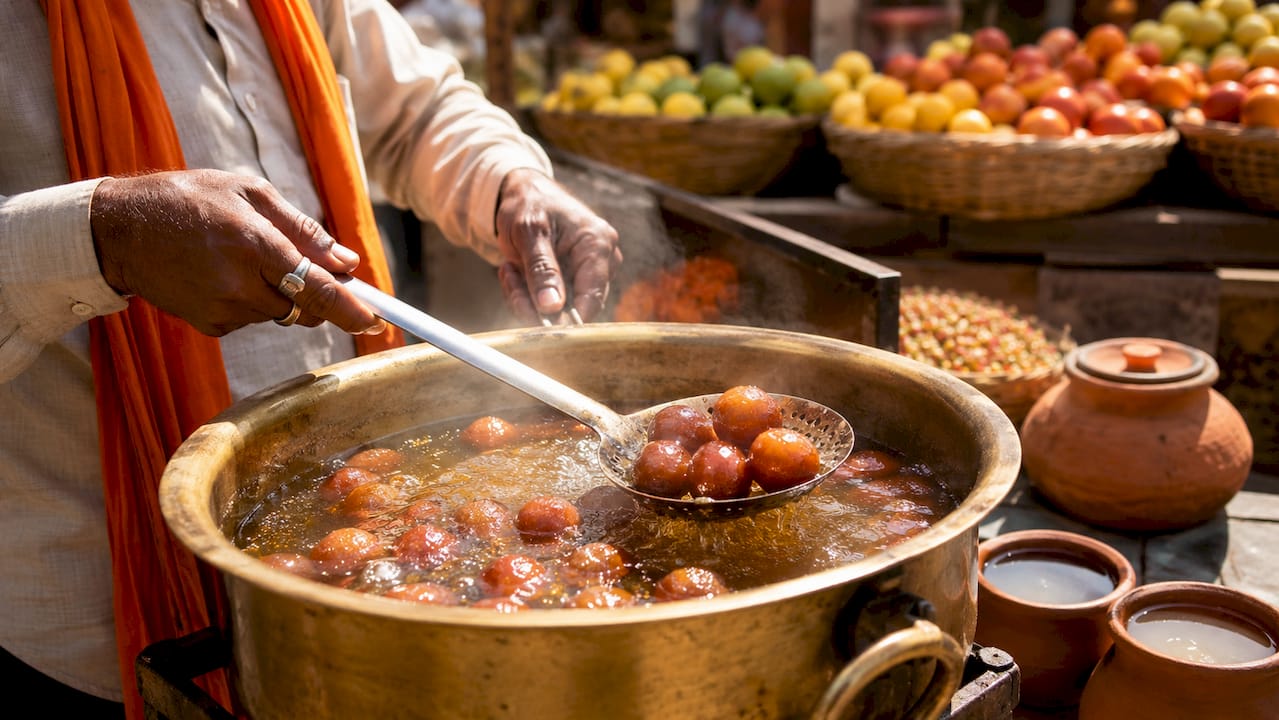
The sensory profile is unmistakable. Each ball is warm, spongy, and saturated with floral syrup that releases with the lightest pressure. Street vendors serve them straight from a wide brass pan, ladled into small clay cups or paper bowls. The syrup soak time directly determines texture: a short soak gives a firmer bite, while a longer rest produces something closer to a pudding.
Key variations worth knowing:
- Kala Jamun: A darker, slightly caramelised version fried longer for a firmer exterior
- Gulab Jamun with ice cream: A modern street-stall twist pairing hot syrup balls with cold vanilla
- Mini Gulab Jamun: Bite-sized versions served at festivals, easier to eat on the move
- Stuffed Gulab Jamun: Filled with pistachio or khoya for added richness
Pro Tip: Always eat Gulab Jamun warm. The syrup thickens as it cools, and the spongy texture firms up. A vendor who serves them straight from the pan is the one to trust.
2. jalebi: vibrancy in every spiral
Jalebi is a deep-fried fermented batter shaped into spirals, soaked in sugar syrup, and served hot. The fermentation step is what separates authentic Jalebi from imitations. It creates a faint tang that cuts through the sweetness and gives the batter its characteristic chew.
The texture contrast is the real draw. The outside is crunchy and lacquered with syrup. The inside is sticky and dense. Eating one hot from the oil is a completely different experience from eating one that has sat for twenty minutes. That gap in quality is why street-side Jalebi, made to order, remains the gold standard.
Regional differences across India are significant:
- North India: Thicker spirals, heavier syrup, often served as a breakfast sweet with warm milk
- West Bengal: Thinner, crispier version known locally as Jilapi
- Maharashtra: Sometimes made with a wheat-flour batter for a denser result
- Rajasthan: Served alongside Mawa Kachori as a festival pairing
The most celebrated pairing is Jalebi with chilled Rabri. The hot, crispy spiral meets cold, thickened cream. The contrast shifts the flavour from pure syrupy sweetness to something layered and balanced. This combination is a cultural institution across North India.
Pro Tip: Order Jalebi only when you can see the vendor actively frying. Pre-made Jalebi loses its crunch within minutes. The syrup penetrates too deeply and the spiral goes limp.
3. rasgulla, kulfi, and rabri: three regional icons
These three desserts represent the breadth of India’s popular street desserts list. Each comes from a distinct tradition and delivers a completely different sensory experience.
| Dessert | Origin | Texture | Key Flavour | Best Served |
|---|---|---|---|---|
| Rasgulla | Bengal and Odisha | Spongy, light | Mild, milky | Chilled or at room temperature |
| Kulfi | Mughal North India | Dense, creamy | Pistachio, rose, malai | Frozen on a stick |
| Rabri | Rajasthan and UP | Thick, layered | Saffron, cardamom | Cold, as a pairing |
Rasgulla is made from chenna, a fresh cottage cheese, rolled into balls and cooked in a light sugar syrup. The result is a soft, almost bouncy sweet that absorbs syrup without becoming heavy. Bengal and Odisha both claim its origin, and the rivalry between the two states over the dessert’s birthplace is a genuine cultural debate.
Kulfi is creamier and denser than Western ice cream because it is made by slowly reducing milk before freezing, with no churning involved. That process concentrates the milk solids and produces a richness that no soft-serve can replicate. Classic flavours include malai (clotted cream), pistachio, and rose. Street vendors serve it on a wooden stick or pressed into a small clay pot called a matka.
Rabri is slow-cooked thickened milk infused with saffron and cardamom. On its own, it is a dessert. Alongside hot Jalebi, it becomes a pairing that defines North Indian street food culture. The temperature and texture contrast between the two is the point.
4. lesser-known street sweets that deserve your attention
The top Indian street desserts extend well beyond the famous names. Many iconic sweets are tied to specific regions and festivals, reflecting local pride and culinary history that rarely travels beyond their home state.
These five are worth seeking out:
- Mysore Pak: A dense, ghee-rich fudge from Karnataka made with chickpea flour. The texture is grainy and buttery, and the flavour is intensely nutty. It was originally created in the royal kitchens of Mysore Palace.
- Ghevar: A disc-shaped Rajasthani sweet made from a latticed batter fried in ghee, then soaked in syrup and topped with Rabri and pistachios. It appears almost exclusively during the Teej and Raksha Bandhan festivals.
- Malpua: A soft, syrup-soaked pancake from Odisha and Rajasthan, often flavoured with fennel and cardamom. Street vendors fry them in shallow ghee and serve them hot with a drizzle of condensed milk.
- Churma Ladoo: A Rajasthani ball-shaped sweet made from coarsely ground wheat, ghee, and jaggery. It is dense, warming, and deeply satisfying in cold weather.
- Balushahi: Sometimes called the Indian doughnut, this flaky, glazed sweet from North India is made from maida dough fried until golden and dipped in sugar syrup. The layers peel apart like pastry.
Each of these sweets tells you something specific about the region it comes from. Ghevar’s elaborate construction reflects Rajasthan’s tradition of celebratory excess. Mysore Pak’s simplicity reflects the precision of South Indian cooking. Exploring this guide to Indian dessert selection gives you a far richer picture of the country than the famous names alone.
5. how to choose and enjoy indian street desserts authentically
The freshness of street desserts is the single most important quality indicator. Jalebi’s crunch and Gulab Jamun’s syrup sheen both disappear within an hour of preparation. Knowing what to look for protects you from a disappointing experience.
Sensory cues to check before ordering:
- Syrup consistency: Fresh Gulab Jamun syrup should be glossy and fluid. Thick, cloudy syrup means the dessert has been sitting too long.
- Temperature: Jalebi and Gulab Jamun should be warm to the touch. Kulfi should be fully frozen with no soft spots.
- Colour: Jalebi should be a deep amber, not pale yellow. Pale Jalebi has not been fried long enough and will be doughy inside.
- Aroma: Cardamom and rosewater should be detectable from close range. A flat, neutral smell suggests old syrup or weak spicing.
Pairing suggestions that reflect authentic Indian eating customs:
- Jalebi with chilled Rabri for temperature and texture contrast
- Gulab Jamun with a small cup of masala chai to balance sweetness with spice
- Kulfi with a sprinkle of crushed pistachios and a few strands of saffron
For those enjoying Indian street food pairings outside India, the key is replicating the vendor’s habit of immediate service. Restaurants that prepare desserts to order, rather than in advance, come closest to the original experience.
Pro Tip: When ordering at an Indian restaurant abroad, ask whether the Gulab Jamun is served warm. A kitchen that heats them to order understands the dessert. One that serves them cold from a fridge does not.
Key takeaways
Authentic Indian street desserts are defined by freshness, syrup technique, and regional identity. These qualities separate a memorable sweet from a forgettable one.
| Point | Details |
|---|---|
| Freshness is non-negotiable | Order Jalebi and Gulab Jamun only when freshly prepared to preserve texture and flavour. |
| Syrup technique defines quality | Soak time and syrup consistency determine whether a dessert is firm, spongy, or soggy. |
| Regional identity matters | Sweets like Ghevar, Mysore Pak, and Rasgulla each carry specific cultural and geographic meaning. |
| Pairings amplify the experience | Jalebi with Rabri and Gulab Jamun with chai are culturally grounded combinations, not suggestions. |
| Sensory cues guide selection | Colour, temperature, aroma, and syrup sheen are reliable indicators of quality before you taste. |
What indian street desserts taught me about eating well
I have eaten Jalebi in Chandni Chowk at six in the morning, standing at a stall that had been frying since before dawn. I have had Kulfi from a cart in Jaipur that tasted of nothing but cold pistachio and time. Neither experience was replicable in a restaurant, but both taught me something that I carry into every food conversation I have.
Indian street desserts are not a category of food. They are a philosophy of service. The dessert is only as good as the moment it is made. That idea runs counter to how most Western restaurants think about sweets, where desserts are plated hours in advance and held at temperature. The Indian street model demands presence. Vendor and customer are both part of the transaction.
What I find most underappreciated is the role of contrast. Every great Indian street sweet is built on opposition: hot against cold, crispy against syrupy, floral against earthy. Jalebi and Rabri is the clearest example, but the same logic applies to Kulfi served on a warm afternoon or Gulab Jamun dropped into a cup of spiced tea. The contrast is not accidental. It is the point.
For anyone building their own authentic Indian food knowledge, I would say this: start with the desserts. They are the most honest expression of a region’s ingredients, techniques, and values. A kitchen that makes good Gulab Jamun understands heat, timing, and restraint. Those are the same qualities that make everything else on the menu worth eating.
— YellowRock
Taste these sweets at Desigallibcn in barcelona
Desigallibcn brings the flavours and spirit of Indian street food to the centre of Barcelona. The restaurant is built around the same principles that make Indian street desserts so compelling: bold spice, fresh preparation, and dishes that reflect real culinary tradition rather than a diluted version of it.
Whether you are new to Indian sweets or already know your Rasgulla from your Rabri, Desigallibcn offers a setting where those flavours make sense. The menu draws from the same street-food traditions described in this article. Explore Indian street food in Barcelona and discover what authentic preparation actually tastes like. Booking is straightforward, and the kitchen takes freshness as seriously as any vendor in Delhi or Kolkata.
FAQ
What is the most popular indian street dessert?
Gulab Jamun is widely considered the most popular Indian street dessert. It appears at celebrations, festivals, and street stalls across every region of India.
Why is jalebi always served hot?
Jalebi is served hot because heat preserves its crispy exterior. Once it cools, the syrup penetrates fully and the crunch disappears, leaving a limp, overly sweet spiral.
What makes kulfi different from ice cream?
Kulfi is made by slowly reducing milk before freezing, with no churning. This produces a denser, creamier texture and a more concentrated flavour than standard ice cream.
Which indian street desserts are vegetarian?
All the desserts on this list, including Gulab Jamun, Jalebi, Rasgulla, Kulfi, Rabri, Mysore Pak, and Ghevar, are vegetarian. Most are also free from eggs.
Where can i try authentic indian street desserts in barcelona?
Desigallibcn in Barcelona specialises in authentic Indian street food and desserts, serving dishes prepared with traditional techniques and genuine spicing in a casual, vibrant setting.
Recommended
- Tasty Indian Street Foods For You – Desi Galli
- Street food pairing ideas for Indian flavour lovers – Desi Galli
- Indian food pairing tips for your Barcelona street food – Desi Galli
- Postres indios: su rol cultural real en India y Barcelona – Desi Galli