

Barcelona has long been a city that surprises food lovers. But ask most people about casual Indian dining here and they’ll picture a dim curry house with a laminated menu. The reality is far more vivid. Barcelona’s casual Indian dining scene draws its energy from the bustling street markets of Mumbai, Delhi, and Chennai, offering vibrant vegetarian snacks, bold chutneys, and communal rituals that feel worlds away from a standard curry night out. This guide will walk you through what truly defines the experience, which dishes to try, and how to make the most of every visit.
Table of Contents
- What defines casual Indian dining?
- Signature dishes and street food favourites
- Decor, rituals and the casual dining atmosphere
- Tips for trying casual Indian dining in Barcelona
- Our perspective: Why casual Indian dining in Barcelona is evolving
- Where to experience authentic casual Indian dining in Barcelona
- Frequently asked questions
Key Takeaways
| Point | Details |
|---|---|
| Street food authenticity | Barcelona’s casual Indian dining is grounded in vibrant street food traditions and vegetarian authenticity. |
| Immersive atmosphere | Many venues offer street-style decor, communal rituals, and welcoming ambience to enhance the experience. |
| Signature vegetarian dishes | Menus feature small plates and classics like samosas, dosas, and chaats, reflecting regional Indian flavours. |
| Practical tips | Seek authentic venues, share plates, and embrace dining rituals for a more rewarding culinary adventure. |
What defines casual Indian dining?
Casual Indian dining is not one single thing. It sits somewhere between a quick street snack eaten standing up in Chandni Chowk and a relaxed table setting where friends share small plates for two hours. The format has evolved dramatically, with some venues pushing the experience towards something immersive and theatrical, complete with street-style murals, open kitchens, and chaat counters, whilst others remain honest neighbourhood spots focused purely on flavour and value.
What Barcelona does differently is worth noting. Rather than chasing the fusion trend popular in cities like London or New York, the best casual Indian spots here stay grounded in vegetarian and street food authenticity. You won’t find tikka masala pizza or curry-infused tapas on the menus worth visiting. Instead, you’ll find dishes rooted in regional Indian tradition, prepared with proper spice blends and served in ways that reflect their origins.
Here is what genuinely sets casual Indian dining apart from other formats:
- Street food heritage: dishes designed to be eaten quickly, cheaply, and with maximum flavour
- Vegetarian focus: India’s rich vegetarian culinary tradition is front and centre, not an afterthought
- Communal format: sharing plates, chutney trays, and shared beverages like chai or lassi
- Accessible pricing: casual dining means quality food without fine dining price tags
- Lively atmosphere: noise, colour, and energy that mirrors an actual Indian market setting
“In Barcelona, the focus falls firmly on vegetarian and street food authenticity over fusion, setting it apart from the generic Indian restaurant model seen elsewhere in Europe.”
Before you visit anywhere, it is worth checking the authentic Indian gastronomy checklist to understand what markers separate a genuinely authentic spot from one simply trading on Indian aesthetics. And if you are curious about the broader movement, the reasons behind Indian street food popularity in Barcelona reveal a fascinating shift in how the city eats.
Signature dishes and street food favourites
Once you understand the concept, the food itself becomes the main event. Barcelona’s casual Indian dining menus lean heavily on the kind of dishes you’d find sold from handcarts and market stalls across India. These are not simplified versions cooked down for a European palate. The best kitchens use tamarind, chaat masala, fresh coriander, and asafoetida the way they are meant to be used.
Here are the dishes you are most likely to encounter, roughly in order of how commonly they appear:
- Samosas: The undisputed icon. Crispy pastry filled with spiced potato and peas, served with mint chutney and tamarind sauce. A well-made samosa has a shell that shatters on the first bite.
- Pani puri / golgappa: Hollow, crispy spheres filled with spiced water, chickpeas, and potato. Eaten in one go. Possibly the most exciting single mouthful in all of street food.
- Chaat: A family of dishes rather than one dish. Aloo tikki chaat, papdi chaat, and bhel puri all combine sweet, sour, spicy, and crunchy elements in ways that feel chaotic but land perfectly.
- Dosas: South Indian fermented rice and lentil crepes, served with sambar and coconut chutney. Crispy at the edges, soft in the middle, deeply savoury.
- Dal makhani: Slow-cooked black lentils with butter and cream. One of the great vegetarian comfort dishes of North India, and one that rewards patience in preparation.
- Lassi: Sweet or salted yoghurt drink, the natural partner for spicy food and a staple of any genuine Indian street food setting.
The table below gives a useful regional overview of what you’re tasting and where it originates:
| Dish | Region of origin | Primary flavour profile | Vegetarian |
|---|---|---|---|
| Samosa | North India | Spiced, savoury, crispy | Yes |
| Pani puri | West India (Mumbai) | Tangy, spicy, refreshing | Yes |
| Dosa | South India (Tamil Nadu) | Fermented, earthy, crispy | Yes |
| Chaat | North India | Sweet, sour, spicy, crunchy | Yes |
| Dal makhani | Punjab | Rich, buttery, smoky | Yes |
| Vada pav | Maharashtra | Spiced potato, soft roll | Yes |
The casual dining trend confirms what Barcelona’s best kitchens already know: vegetarian and street food authenticity, not fusion experimentation, is what drives genuine interest and repeat visits.
Pro Tip: If a menu lists chaat without specifying the type, ask the staff which version they make in-house from scratch. Freshly assembled chaat tastes completely different from pre-prepared versions that sit and go soggy.
To get the full picture of what to order and how to navigate a first visit, how to enjoy Indian street food in Barcelona walks you through the process step by step. And if you’re wondering why these dishes are more than just tasty snacks, the Indian street food benefits piece explains the nutritional and cultural value packed into each bite.
Decor, rituals and the casual dining atmosphere
Food is only part of the experience. The atmosphere and rituals of casual Indian dining are what transform a meal into something you remember and want to repeat. Understanding the environment before you walk in makes the whole thing more enjoyable.
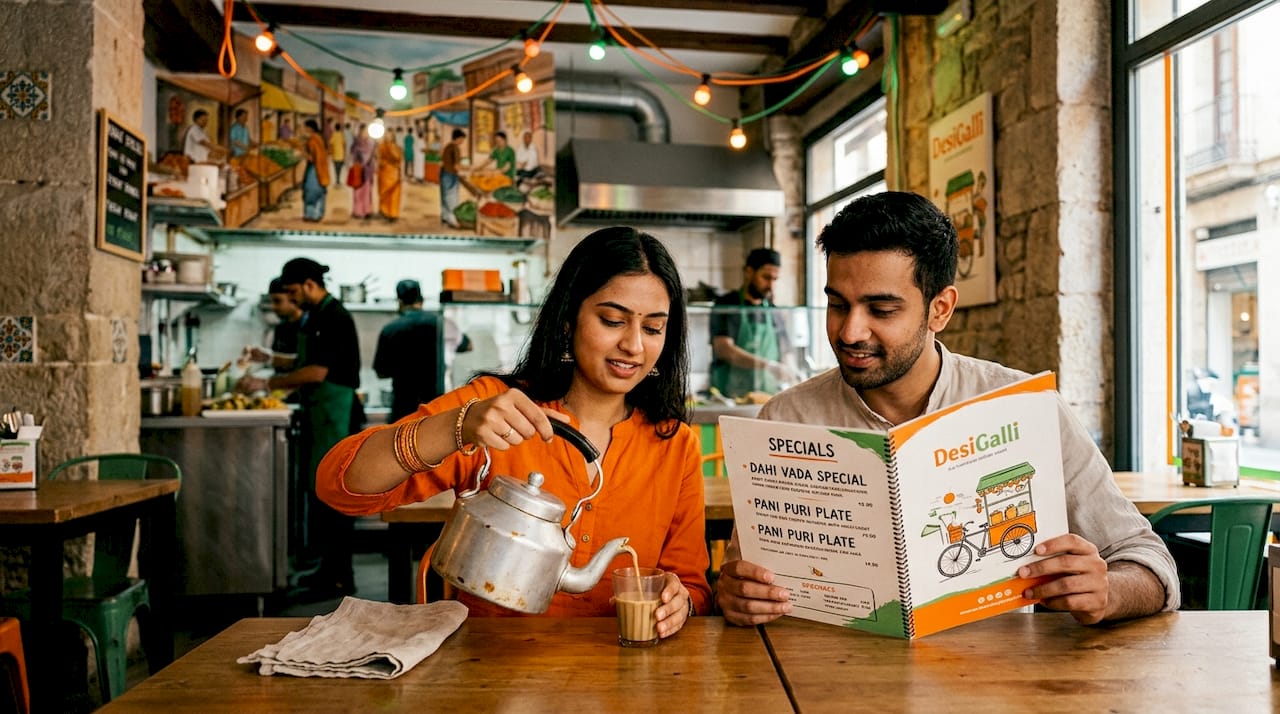
There is a real contrast between the two main styles of casual Indian venues you’ll find in Barcelona:
| Feature | Street-inspired venue | Neighbourhood eatery |
|---|---|---|
| Decor | Murals, market stalls, open kitchen | Simple, minimal, functional |
| Service | Counter ordering or shared plate service | Traditional table service |
| Lighting | Warm, colourful, festive | Practical, understated |
| Noise level | High energy, background music | Quieter, conversational |
| Authenticity markers | Regional dishes, spice station | Familiar menu, homestyle cooking |
| Best for | Groups, explorers, first-timers | Regular local visitors |
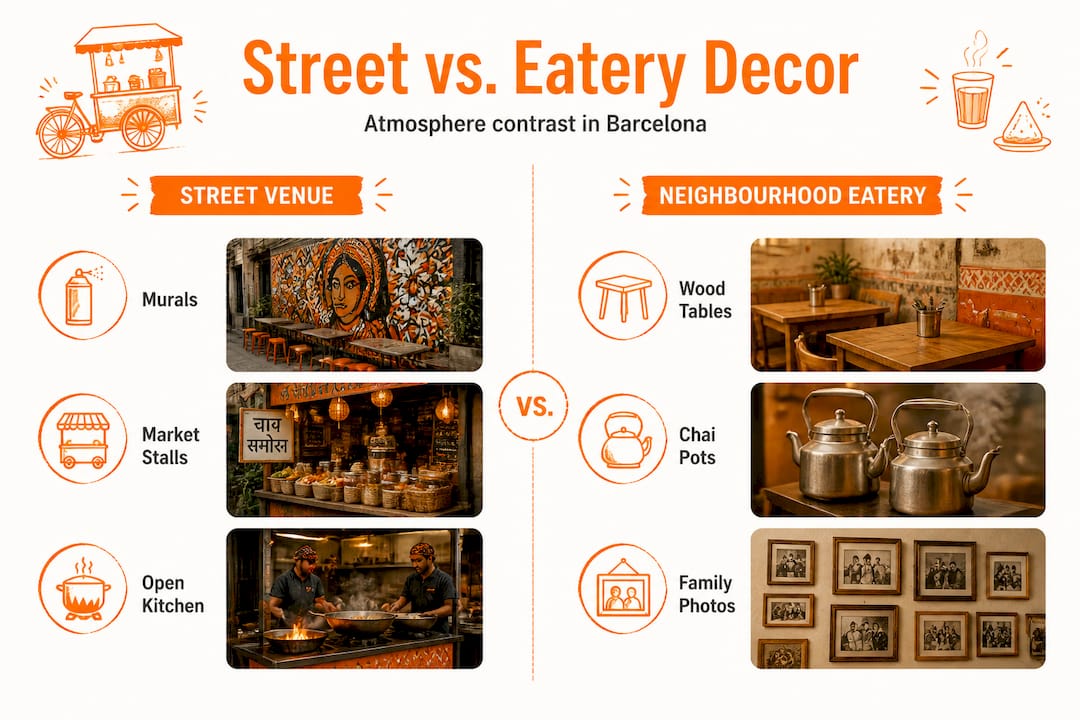
The street-style decor approach is increasingly popular because it does more than look interesting. It sets the mood for how you eat. When the environment feels like a market, you naturally relax, share, and try things you might not order in a formal setting.
Beyond decor, the rituals matter enormously. Here are the customs that define the casual Indian dining experience at its best:
- Handwashing before eating: Still practised in many authentic settings. Some venues keep a small sink or provide hot towels as a nod to this tradition.
- Chutney trays: A selection of chutneys arrives before or with the food. Mint, tamarind, and raw onion chutney are the most common. These are not condiments. They are essential components of the meal.
- Communal eating: Dishes are placed in the centre of the table and shared. Ordering individually defeats the purpose of a menu built around variety.
- Chai service: Masala chai served in small glasses or clay cups is the natural full stop to a casual Indian meal.
The culinary Indian experience in Barcelona is increasingly shaped by venues that take these rituals seriously rather than stripping them away for convenience. Understanding what draws people to Indian food in Barcelona also sheds light on why this sensory, communal approach resonates so strongly with the city’s food-curious population.
Tips for trying casual Indian dining in Barcelona
Knowing what casual Indian dining is and what it offers is one thing. Actually getting the best out of your visit requires a bit of practical preparation. These tips will help you avoid the most common mistakes and arrive ready to eat well.
- Prioritise vegetarian menus: Even if you eat meat, a menu with genuine vegetarian depth signals a kitchen that understands Indian cooking from the ground up. Meat-heavy menus often sacrifice spice complexity for familiar comfort.
- Look for street food inspired settings: Venues that replicate the energy of an Indian street market are more likely to serve dishes in their intended format, with proper accompaniments and timing.
- Arrive hungry and order widely: Casual Indian dining is not a starter and main situation. Order multiple small dishes across the table and graze. Five or six dishes between two people is a perfectly normal approach.
- Ask about regional specialities: Any kitchen worth visiting will have dishes that reflect a specific Indian region. Asking about these starts a conversation and often leads to the best recommendation on the menu.
- Embrace the chutney: Don’t treat the chutneys as background decoration. They balance heat, cut through richness, and add entirely new dimensions to each dish.
- Try the drinks: A mango lassi or masala chai changes the experience of eating spiced food in a way that water simply cannot replicate.
As current trends confirm, the focus in Barcelona’s best casual Indian spots is firmly on authentic vegetarian street food rather than crowd-pleasing fusion. Use this as your compass when choosing where to eat.
Pro Tip: Visit during lunchtime on your first try. Kitchens are at their freshest, portion sizes at casual Indian spots are often generous at lunch, and the atmosphere tends to be more relaxed than peak dinner service.
Keep the authentic Indian dining checklist bookmarked for reference when researching venues. And once you’ve found a spot, revisit enjoying Indian street food for a deeper practical guide to making every order count.
Our perspective: Why casual Indian dining in Barcelona is evolving
Most people assume casual Indian dining is simply a cheaper, less formal version of a traditional Indian restaurant. We think that misses the point entirely, and the evolution happening in Barcelona is the best evidence of why.
Barcelona’s food culture is exceptionally demanding. Locals who eat pintxos in San Sebastián, fresh pasta in Rome, and patatas bravas on the Rambla every week are not easily impressed by generic interpretations of any cuisine. They want specificity. They want to taste the difference between a Punjabi samosa and a Gujarati one. They want chaat assembled in front of them, not plated two hours earlier. That demand for precision is reshaping what casual Indian dining looks like in this city.
The shift towards veg-focused authenticity is not just a trend response. It reflects a genuine alignment between Indian culinary tradition and Barcelona’s growing health-conscious, plant-curious dining population. India has centuries of vegetarian cooking that stands completely on its own without needing meat as a foundation. Bringing that tradition to Barcelona, without watering it down, is both a culinary and cultural act.
We also believe the communal, ritual-based format of Indian street food creates something that individual plating cannot. When you share a chutney tray, pass dishes around a table, and pour chai together, you build a different kind of connection to the food and to the people you are eating with. That is not an accident. It is baked into the way Indian street food has always worked, and it is increasingly why people seek it out over more formal dining formats.
The restaurants getting this right in Barcelona are not trying to replicate London’s Indian food scene or New York’s. They are building something specific to this city, this audience, and this moment. And that, in our view, is the most exciting development in Barcelona’s dining landscape right now.
Where to experience authentic casual Indian dining in Barcelona
If everything above has made you ready to book a table, start with the best reference point the city offers. Desi Galli brings the full casual Indian street food experience to the heart of Barcelona, from freshly assembled chaats and crispy samosas to warming dal and perfectly spiced chai. The focus is firmly on Indian street food rituals and vegetarian authenticity, exactly what Barcelona’s food-curious crowd is looking for.
For a broader look at what the city offers, the guide to top Indian street food options in Barcelona compares eight spots worth knowing about. Whether you’re a first-timer or a regular, visiting a genuinely casual Indian street food restaurant gives you the clearest, most flavour-packed introduction to what this cuisine does best.
Frequently asked questions
What is casual Indian dining?
Casual Indian dining combines street food traditions, authentic flavours, and a relaxed communal atmosphere, with a strong focus on vegetarian dishes and shared eating rituals rather than formal plated menus.
How does casual Indian dining in Barcelona differ from traditional Indian restaurants?
Barcelona’s casual Indian dining highlights vegetarian street food and immersive rituals over fusion or standard curry house menus, with kitchens drawing directly on regional Indian traditions rather than adapting to European expectations.
What are the most popular Indian street food dishes in Barcelona?
The most popular dishes include samosas, pani puri, chaat, dosas, and dal makhani, all representing authentic vegetarian Indian street food served in their traditional form rather than fusion interpretations.
How should I choose a casual Indian dining spot in Barcelona?
Look for venues that prioritise vegetarian menus, feature street food inspired decor, and honour communal eating customs like chutney trays and shared plates. These details signal a kitchen serious about authenticity.
Recommended
- Indian street food: Flavours, rituals and where to try in Barcelona – Desi Galli
- Benefits of Indian street food in Barcelona – Desi Galli
- 🎖️ Restaurante de Comida India Callejera en Barcelona
- Why Indian street food is popular in Barcelona – Desi Galli
- Bar Hopping Barcelona | Rban Tours


Comments(02)